

Page 3, 12th July 1974
Page 3
Report an error
Noticed an error on this page?If you've noticed an error in this article please click here to report it.
Tags
Share
Related articles
Walsingham Still The Nation's Favourite Place Of Pilgrimage
Archbishop Led Birmingham Men To Walsingham
Golden Walsingham
Walsingham: Where Piety And Sightseeing Pleasure Go Hand...
They Went From Chelsea Two Hundred Strong
PETER JENNINGS JOINS A PILGRIMAGE TO THE NATIONAL SHRINE OF OUR LADY, WALSINGHAM ENGLAND'S NAZARETH
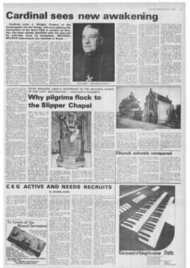
Why pilgrims flock to the Slipper Chapel
Last weekend I joined a Birmingham Archdiocesan Holy Year Pilgrimage to the National Shrine of Our Lady, Walsingham, under the spiritual directorship of Canon Wilfrid Smith, Administrator of Father Hudson's Homes, at Coleshill near Birmingham.
As the coach approached the quaint little village of Walsingham we sang the famous "Pilgrim Hymn", "0 Mary, 0 Mother reign o'er us once more, Be England thy 'dowry' as in days of yore."
The little 14th century Slipper Chapel, an outstanding example of English medieval architecture, holds about only 30 people and so during the afternoon, Canon Smith celebrated a sung Latin Mass of Our Lady in the new open-sided church, the first stage of which was completed in the Chapel grounds last year.
Now more than 60 priests can celebrate Mass at the altar, while there is covered accommodation for a congregation of about 300 people and on special days it is possible for a congregation of several thousand to stand in the meadow and follow Mass.
The new altar, a massive slab of polished Aberdeen granite: a gift from members of the Union of Catholic Mothers, was consecrated on July 3 last year by Bishop Charles Grant of Northampton. Work on the completion of this much needed church, costing in the region of 150,000, has halted because of lack of funds.
All meals were efficiently served in Pilgrim Hall by Extremely hard working and enthusiastic young schc;olgirl volunteers from Norwich and Cambridge. After supper, Fr Roland Connelly, the Administrator of the Shrine. since the Marist Fathers took over in 1968, preached at the Pilgrims' Service and Benediction held in Friday Market Church.
Also situated in the picturesque little Friday Market is the Hostel for Pilgrims which can accommodate up to 120 people. Attached to the Hostel is a Pilgrim Club. where one can chat to fellow pilgrims in a relaxed and convivial atmosphere.
During his instructive sermon, Fr Connelly reminded pilgrims that they were following a very old tradition in corning to Walsingham but they should not live in the past, whether it be days of glory or persecution.
It was to a 'living' Shrine which they came. "As pilgrims we often take the wrong road many times during our life and many times we fall by the wayside, but here in Walsingham we feel the sense of support, help and encouragement from fellow pilgrims seeking for a deeper knowledge of God and of themselves."
Fr Connelly told me that it was his ambition to build up a Shrine of universal appeal to both young and old, men and women, a place where deeply religious or not so religious, would find themselves at home.
"I always have a "Walsingham struggle' because of lack of staff, accommodation and money," he said. "Last year we had about 30,000 pilgrims here in organised parties and this is twice as many as in 1968."
After breakfast on Sunday, we walked in procession along the 'Holy Mile' to the Slipper Chapel for Mass. The pilgrimage ended with Benediction at the Church of the Annunciation in King's Lynn. This link is retained because in 1897 a new statue of Our Lady of Walsingham was erected in Walsingham's then Catholic Parish Church at King's Lynn.
Also on August 20 of that year the first modern pilgrimage came to Walsingham after a gap or many years.
In 1893, an Anglican lady, Miss Charlotte Boyd (18371906) sought to buy the famous Slipper Chapel at Houghton St Giles, in which pilgrims of ancient times heard Mass before making the last stage of their journey to the Shrine of Walsingham just over a mile away.
At her own expense Miss Boyd restored this little chapel and it was while she was doing so that she became a Catholic. On completion she gave it, to the Benedictine monks of Downside who looked after it carefully until 1934, when they handed it to the Diocese of Northampton.
In 1934, Cardinal Bourne (the first Cardinal to tread the Walsingham Way since Cardinal Wolsey) led a National Pilgrimage of 12,000 people to the Slipper Chapel to celebrate the restoration of the Shrine and on September 8, 1938, the Slipper Chapel was solemnly consecrated.
On the Feast of the Assumption 1954, with permission from the Holy Father, the statue of Our Lady of Walsingham was solemnly crowned by the Apostolic Delegate, Archbishop O'Hara before about 15,000 pilgrims. This is one of the very few statues in the world to be so honoured.
The little Slipper Chapel was the last of several wayside chapels which the pilgrim came to on his way to Walsingham. In it is the magnificent carved wooden statue of Our Lady of Walsingham which is surrounded by an array of colour. flowers and burning candles. Here, too, one finds the true peace and ,prayerful quietness that is so characteristic of Walsingham.
The Walsingham Emblem is one of the motifs on the gilt pinnacle above the figure of Our Lady in the Chapel. It consists of M for Mary and W for Walsingham surmounted by the Saxon crown denoting the date of the founding of the original Shrine in 1061.
We are told in the Pynson Ballad that a lady of the village, Richeldis de Faverches, was transported as if in a dream to the Holy Land and there shown the Holy House of Nazareth where the Annunciation had taken place.
She was told to return to Walsingham and there to build a replica of that Holy House, which she did. It was to this little house of wood and wattle that pilgrims came from all over the country to pray to Our Lady.
A great Priory of Augustinian Canons was built and for centuries the Shrine of Our Lady . and the Priory Church stood side by side. HoWever, at the Reformation, King Henry VIII ruthlessly destroyed the Shrine.
The Holy House itself was
burnt to the ground and the Statue of Our Lady was taken to London and burnt at Chelsea in 1538. Today nothing remains of the original house, but archaeologists have proved the site in the Priory grounds, so it is at least possible to pray at the place where so many of our fore fathers s honoured Our Lady of Walsingham, all those years ago.
blog comments powered by Disqus